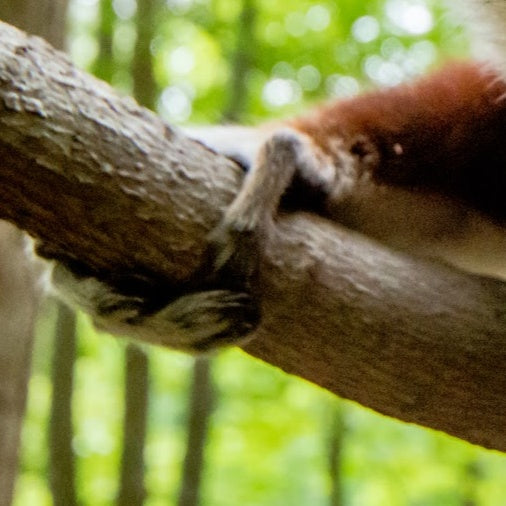
Sifaka Stare
Sifaka Stare
Those amber eyes don't just look at you — they look through you. This close-up portrait of a Coquerel's Sifaka (Propithecus coquereli) captures a split-second of unbroken eye contact that collapses 60 million years of evolutionary distance into a single, breathtaking frame.
Shot at the Duke Lemur Center in Durham, NC (the world's largest collection of lemurs outside Madagascar) this image carries the rare authenticity of semi-wild photography: no staged backdrop, no artificial light, just a critically endangered primate and a held gaze that refuses to let go.
Wondering what makes this different from typical wildlife photography? This is a portrait. The Sifaka turned, locked its gaze on the lens, and the rest of the world disappeared. The result is something closer to a conversation than a capture — one framed by lush, dappled green canopy and the rough texture of a hardwood branch gripped with quiet confidence.
The white fur halo, rust-brown body, and wide-set golden eyes are rendered with striking clarity against soft bokeh.
Looking for wall art that genuinely stops people mid-step? This piece works in modern living rooms, wildlife-themed offices, conservation spaces, and anywhere you want to spark the question: what is it thinking?
It also makes a compelling gift for primatologists, lemur enthusiasts, nature photographers, and anyone who believes the most powerful portraits don't always have human subjects.
Bring home a piece of one of the most important conservation sites on earth — and let the Sifaka hold its gaze on your wall!
Frequently Asked Questions
Where was this photograph taken?
At the Duke Lemur Center in Durham, North Carolina — the world's largest collection of lemurs outside Madagascar and a leading institution in primate conservation research.
What species is the Sifaka?
A Coquerel's Sifaka (Propithecus coquereli), a critically endangered primate native to northwestern Madagascar. Fewer than 10,000 are estimated to remain in the wild, making conservation photography like this an important part of raising awareness.
Is this a wild or captive animal?
Semi-wild. The Duke Lemur Center provides naturalistic habitats where lemurs roam freely in forested enclosures. No artificial lighting or staging was used — the eye contact was entirely spontaneous.
What interior styles does this print suit?
Modern living rooms, wildlife-themed offices, conservation spaces, and gallery walls. The soft bokeh background and warm tones complement both neutral and earth-toned interiors.
Who is this a good gift for?
Primatologists, lemur enthusiasts, conservation advocates, wildlife photographers, and anyone who believes the most powerful portraits don't always have human subjects.
Couldn't load pickup availability